
No products in the cart.: ₹0.00

Indian Flag History: Evolution, Meaning and Interesting Facts About Tiranga
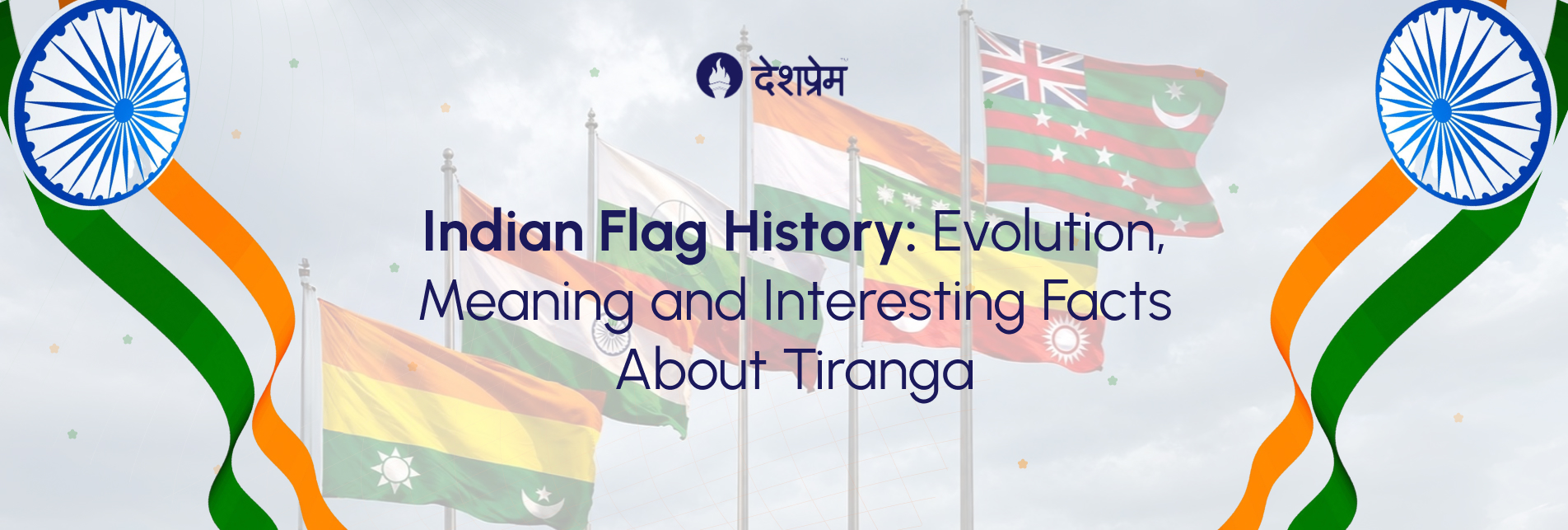
India’s national flag, which is often called the Tiranga, is a sign of freedom, togetherness, and pride for the country. It makes people remember the movement for independence and the efforts of people. Studying the Indian flag history helps us see how different designs slowly changed into the flag that was chosen in 1947. The Tiranga has three horizontal stripes—saffron, white, and green—with a deep blue Ashoka Chakra in the middle.
The official flag has a ratio of width to length of 2:3, and the Chakra has 24 equally spaced spokes. The story of Indian flag history also tells us how national leaders looked for a design that could represent the diversity, values, and future hopes of India. Today the flag gives a common sense of belonging, responsibility, and respect for the nation to the Indians.
Early Development of the Indian Flag
According to reports, one of the earliest national flags was allegedly hoisted on 7 August 1906 at Parsee Bagan Square in Calcutta (now Kolkata). It had green, yellow, and red bands. It had lotuses, the words “Vande Mataram,” the sun, and a crescent moon. This design was a reflection of the growing desire to create a common symbol for India’s freedom movement.
Another was adopted by Indian revolutionaries abroad led by Madame Bhikaji Cama in 1907. Another design was adopted in 1917 during the Home Rule Movement. These versions are important in the history of the indian national flag history because they show how ideas about independence and national identity developed over time. If you’re looking for a trusted Indian flag manufacturer, Deshprem offers premium-quality national flags, patriotic products, and accessories that comply with Indian standards.
Five characteristic features of the early flag movement were:
- Early flags brought people together in the common cause of freedom from British rule.
- Many designs had cultural and patriotic symbols familiar to Indian communities.
- Early flags carried the message of national awakening, ‘Vande Mataram.’
- Revolutionaries abroad waved the Indian flag to attract international attention.
- Each design gave ideas that later influenced the modern Tiranga.
Pingali Venkayya and the Swaraj Flag
Pingali Venkayya was instrumental in the development of the design that led to the present Tiranga. In 1921 he designed a flag to be presented to Mahatma Gandhi. Red and green were in the first version, and white was added later on. A spinning wheel, or Charkha, stood for self-reliance, dignity of labor, and the Swadeshi movement.
In 1931, the Indian National Congress adopted a tricolor of saffron, white, and green with the Charkha at the center. This was an important milestone in the Indian flag history. Its structure was later to influence the present flag and make the tricolor a recognized symbol of India’s freedom struggle.
Adoption of the Present Indian National Flag in Indian Flag History
The present national flag was adopted by the Constituent Assembly on 22 July 1947, shortly before India’s independence on 15 August 1947. The three colors were retained, but the Charkha was replaced by the Ashoka Chakra. This change gave the flag a wider meaning, associated with justice, law, and peaceful progress.
The Chakra draws inspiration from the wheel displayed on the Lion Capital of Ashoka at Sarnath. This was the moment that mattered most in the Indian national flag history, as it marked the official acceptance of a national symbol for a free India. A beautifully designed desk flag is an excellent way to display patriotism in offices, schools, institutions, and corporate workspaces during national celebrations.
Here are some important things to know about the flags adoption:
- The people who made the rules, for India, the Constituent Assembly, said yes to the Tiranga on 22 July 1947.
- The Indian flag was chosen before India was officially a country.
- They kept the colors that they used in 1931, which are saffron, white, and green.
- The Ashoka Chakra was used to mean law and movement.
- The final design was intended to represent every Indian equally.
Indian Flag Tricolour Meaning
The Indian flag tricolour meaning is closely linked with the values of the nation. Saffron represents courage, sacrifice, and selflessness. White stands for truth, peace, and purity, while green represents growth, prosperity, and India’s close relationship with the land.
Flag Element | Meaning and Significance |
Saffron | Courage, sacrifice, and national dedication |
White | Peace, truth, purity, and ethical conduct |
Green | Growth, prosperity, fertility, and hope |
Ashoka Chakra | Law, movement, justice, and progress |
The broader Indian national flag meaning goes beyond the colors alone. The Tiranga encourages citizens to protect national unity, respect diversity, and contribute positively to the country. Understanding the Indian flag tricolour meaning also explains why the flag is treated with dignity during national celebrations and official ceremonies.
The bigger Indian national flag meaning goes beyond the colors. The Tiranga encourages people to protect unity, respect differences, and give their best to the country. Learning about the Indian flag tricolour meaning also shows why the flag is treated with respect during national events and official functions.


Indian Flag Symbol Meaning
The Indian flag symbol meaning a lot of things to us, like being free, united, and responsible. It shows that people from backgrounds like different religions, cultures, languages, and parts of the country can all live together as one.
Five important values represented by the Tiranga are
- Unity brings India’s diverse communities together under one national identity.
- Sacrifice honors freedom fighters, soldiers, and citizens who served India.
- Peace promotes honesty, tolerance, harmony, and respectful coexistence.
- Growth represents prosperity, hope, and responsible national development.
- Progress encourages India to remain active and focused on the future.
The indian flag symbol meaning remains relevant because citizenship involves responsibilities as well as rights. The Tiranga reminds people to respect the Constitution, protect national unity and work for the common good.
Indian Flag Chakra Meaning
The indian flag chakra meaning is connected with Dharma, righteous conduct, and continuous movement. The navy-blue Chakra has 24 equally spaced spokes and appears in the centre of the white band. It communicates that a nation must continue moving forward to grow.
The wheel also represents law, justice, and peaceful change. Its deeper message is that development should remain connected with truth and morality. Through the Chakra, the India national flag meaning becomes a message of disciplined progress, ethical leadership, and responsible action. Discover more ideas for celebrating national pride with Elegant Accessories that perfectly complement Independence Day, Republic Day, and other patriotic occasions.
Interesting Facts About the Tiranga
The journey of indian flag history contains several interesting facts:
- The present Tiranga was officially adopted on 22 July 1947.
- India gained independence on 15 August 1947, after its adoption.
- The official width-to-length proportion of the flag is 2:3.
- All three horizontal color bands must be equal in width.
- The navy-blue Ashoka Chakra contains 24 equally spaced spokes.
The Flag Code of India provides guidance for the respectful display and use of the Tiranga. A damaged flag should not be displayed, and the national flag should never be placed in a disrespectful position. These rules ensure that the symbol connected with Indian flag history is always handled with dignity.
Frequently Asked Questions
Who designed the Indian national flag?
Pingali Venkayya created the design that became the foundation of the present Tiranga. The final version, featuring the Ashoka Chakra instead of the Charkha, was adopted on 22 July 1947.
What do the three colours represent?
The indian flag tricolour meaning includes courage and sacrifice through saffron, peace and truth through white, and growth and prosperity through green. Together, the colors express India’s ideals and aspirations.
What does the Ashoka Chakra represent?
The indian flag chakra meaning includes Dharma, justice, law, movement, and peaceful progress. Its 24 spokes remind the nation to advance with discipline and moral responsibility.
Conclusion
The Indian flag history that shows how India became a free country. The Tiranga reminds us of the sacrifices people made. It also means peace, prosperity, justice, and progress. When we look at the flag, its colors, and the Chakra, it makes us want to work together, be responsible, and help build a stronger India. The Indian flag is a part of our country’s story.