No products in the cart.: ₹0.00

The Untold Journey of the Indian Flag: From 1906 to Today
Every time the Tiranga rises, millions of hearts rise with it. We salute, we chant Jai Hind, and for a moment, we feel that unbreakable bond of being Indian.
But have you ever wondered how our national flag came to be what it is today?
Its colours, its chakra, its evolution.
It wasn’t always like this. Our flag has a story full of courage, struggle, and dreams of a free India.
This is the untold journey of the Indian Flag. A journey of freedom, identity, and national pride.
Table of Contents
1. The Birth of the First Indian Flag in 1906
The story begins on 7th August 1906, in Kolkata’s Parsee Bagan Square.
This first version of the flag looked nothing like the one we know today.
It had:
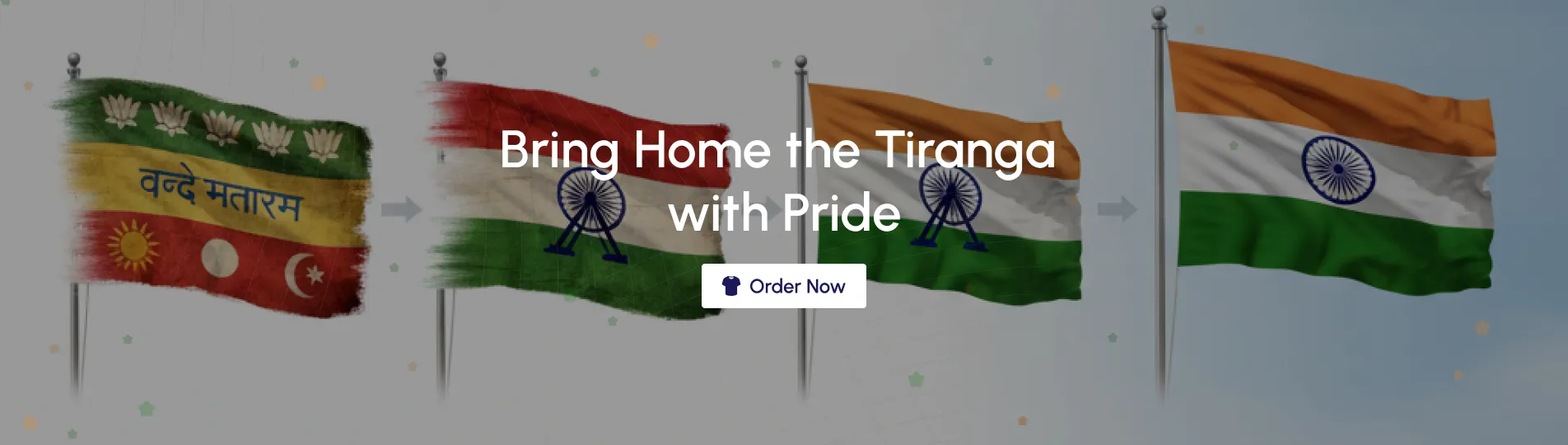
- Three stripes: Green, Yellow, Red
- Eight white lotuses
- Vande Mataram written in the centre
This was the spark. The first visual identity of a nation longing for freedom.
2. The Revolutionary Changes in 1921
Fast forward to 1921.
Freedom fighter Pingali Venkayya presented a new design to Mahatma Gandhi.
It had:
- Red: for Hindus
- Green: for Muslims
Later, Gandhi suggested adding white to represent the rest of India and the spinning wheel as a symbol of self-reliance.
This flag united the country beyond religion. It represented a fight shared by every Indian.
3. 1931: The Flag That Paved the Way
The year 1931 changed everything.
The tricolour was officially adopted for the freedom struggle.
It featured:
- Saffron on top
- White in the middle
- Green at the bottom
- The charkha in the centre
This version became a symbol of courage, peace, and growth. It inspired movements, marches, and sacrifices.
4. 1947: The Tiranga That Symbolises India Today
On 22nd July 1947, the present-day Tiranga was officially adopted.
The only change was replacing the charkha with the Ashoka Chakra, adapted from the Lion Capital of Ashoka.
With 24 evenly spaced spokes, it represented law, progress, and righteousness.
And on 15th August 1947, the Tiranga soared into the sky of a free India for the first time.
5. What the Colours and Chakra Truly Mean
Our flag is not just colours and shapes.
Every part has a soul.
- Saffron reminds us of strength and sacrifice
- White stands for peace and truth
- Green shows prosperity and growth
- Ashoka Chakra is the eternal wheel of justice and progress
It tells the world who we are. A nation that rises, no matter what.
6. The Tiranga in Modern Times
Today, the Tiranga travels everywhere.
From the top of the Himalayas to the depths of the Indian Ocean, from space missions to the digital profile pictures of proud citizens.
You even see the indian flag on t-shirt, badges, and accessories proudly worn by students, professionals, and soldiers.
Thanks to the Har Ghar Tiranga movement, the flag is now part of every Indian home, connecting generations in one emotion: Desh Prem.
7. Where to Own a Piece of This History
Our flag’s journey is emotional and inspiring.
So when you buy or wear the Tiranga, make sure you choose quality, respect, and authenticity.
Whether you are searching for a trusted indian flag manufacturer or a place to buy indian flag online, Desh Prem is dedicated to patriotic products that honour our national identity.
From flags to badges to accessories, you can proudly carry a piece of India’s history wherever you go.
Final Salute
Every time the Tiranga waves, it tells its story.
Of bravery.
Of unity.
Of dreams turned into reality.
This Independence Day, Republic Day, and every day in between, let us honour that story not just by remembering it, but by carrying the Tiranga in our hearts and homes.
Jai Hind. Vande Mataram.
FAQs
What was the first version of the Indian flag before Independence?
The first flag in 1906 had three stripes of green, yellow, and red with lotuses and Vande Mataram written in the centre.
How did the design of the Indian flag change during the freedom movement?
The flag evolved several times with new colours and symbols representing unity, struggle, and identity, finally leading to the tricolour with the Ashoka Chakra in 1947.
What does the Ashoka Chakra represent in today’s Indian flag?
The 24-spoke Ashoka Chakra stands for truth, justice, motion, and continuous progress of the nation.
Where can I buy premium-quality Indian flags, badges, and patriotic accessories inspired by India’s rich flag history?
You can explore Desh Prem for premium and beautifully crafted patriotic merchandise delivered across India.