
No products in the cart.: ₹0.00

Ashok Stambh Meaning: History, Symbolism and Importance of India’s National Emblem

One of the most revered representations of India’s past and identity is the Ashok Stambh. Knowing the meaning of ashok stambh demonstrates how principles like justice, courage, truth, peace, and responsible government still have an impact on contemporary India. It connects the tradition of Emperor Ashoka with the Republic of India and was inspired by Ashoka’s Lion Capital at Sarnath. Ashok stambh meaning moral leadership, patriotism, and upright authority; hence, its significance extends beyond a monument.
What Is Ashok Stambh?
Stone pillars known as ashok stambh meaning were built in the third century BCE during the reign of Emperor Ashoka of the Mauryan Empire. Inscriptions regarding Dharma, compassion, tolerance, justice, and moral behavior were frequently found on these pillars, which were erected at significant places. The significance of Ashok Stambh is strongly related to Ashoka’s endeavor to advance responsible and peaceful government.
Numerous pillars exhibited superb craftsmanship and were constructed from polished sandstone. Additionally, they assisted Ashoka in spreading moral principles throughout his kingdom.
Important Concepts Related to Ashok Stambh
- It is a reflection of Emperor Ashoka’s heritage.
- It stands for accountability, justice, bravery, and the truth.
- It encourages moral and peaceful administration.
- It links Dharma with Indian history.
- India’s official state emblem was inspired by it.
History of Ashok Stambh and Ashok Stambh Meaning
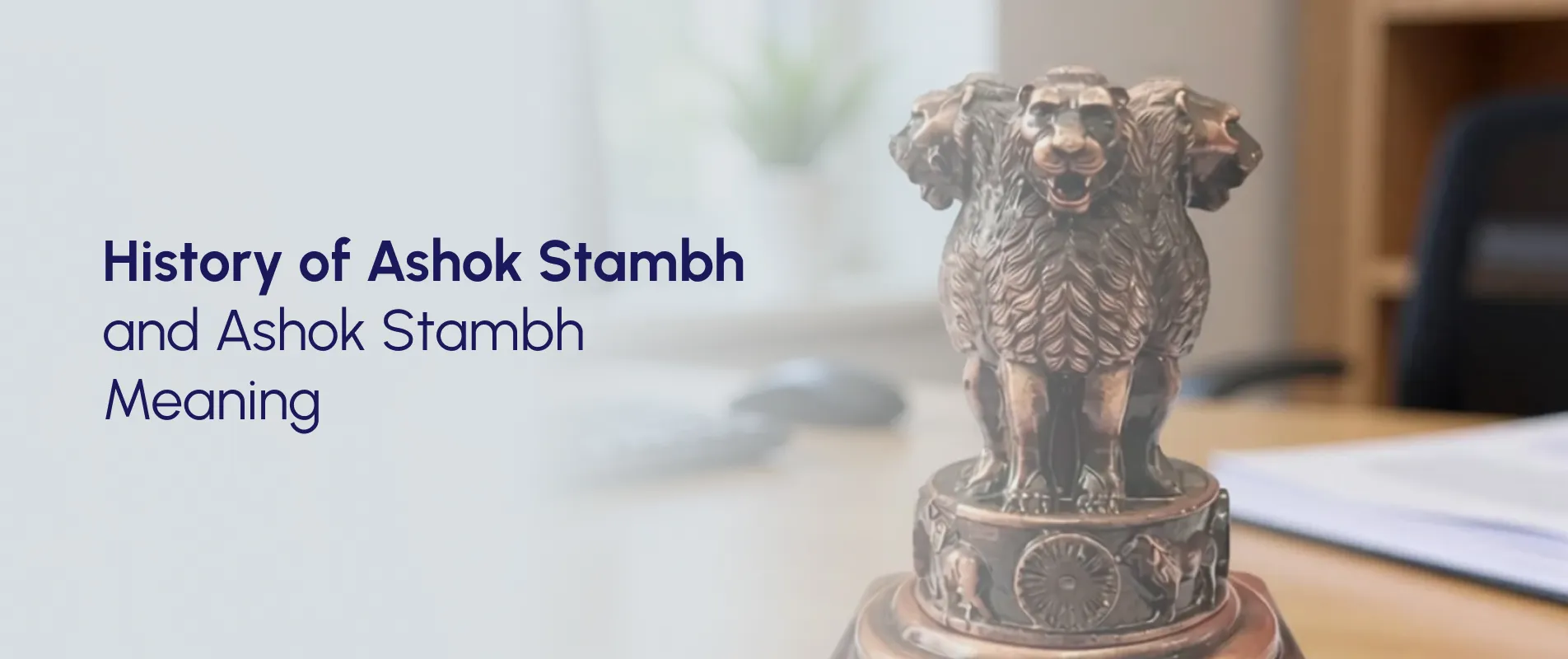
One of the powerful kings of ancient India, Emperor Ashoka, is intimately linked to the history of ashoka pillar. Following the Kalinga War, he concentrated on public welfare, compassion, and Dharma. In order to spread teachings about morality and competent governance throughout his realm, he issued rock edicts and pillars. You can also explore different Ashok Stambh products that reflect India’s cultural and national heritage.
The history of Ashoka pillar also shows how skilled Mauryan artisans were. The smooth surfaces of the pillars were adorned with finely carved capitals, some of which featured horses, lions, bulls, and elephants.
The Lion Capital of Sarnath gained particular significance. It had more significance because it was close to the location where Gautama Buddha is said to have given his first speech.
Important Historical Facts
- In the third century BCE, Ashoka was in power.
- His pillars conveyed teachings on Dharma.
- Many stood at significant places of worship.
- The most well-known example is Sarnath.
- On January 26, 1950, India accepted the insignia.
Ashok Stambh 4 Lions Meaning
Four Asiatic lions are positioned back-to-back and facing four different directions at Sarnath’s Lion Capital. The meaning of Ashok Stambh, which Ashok stambh 4 lions meaning is frequently linked to bravery, strength, self-assurance, pride, and the dissemination of Dharma in all directions. The lions stand for authority that is motivated by morality and fairness.
Only three lions can be seen on India’s official two-dimensional emblem since the fourth lion faces the other way. When the lions are seen with the wheel and animals beneath them, which stand for mobility, stability, and advancement, the Ashok stambh 4 lions meaning becomes more apparent.
Balance between strength and responsibility is also shown in the Ashok stambh meaning. The Dharma Chakra reminds us that authority should be led by justice, truth, and the law, while the lions convey power.
What the Four Lions Represent
- Courage to stand for what is right.
- Strength to protect justice.
- Confidence in good governance.
- Pride in India’s heritage.
- Dharma spreading in all directions.


Symbols Used in the National Emblem
The Dharma Chakra, horses, bulls, lions, and the mantra “Satyameva Jayate” are among the national emblem symbols of India. Each component conveys significant national values and adds to the overall meaning.
The 24 spokes of the Dharma Chakra stand for moral order, advancement, movement, and righteousness. The bull stands for strength and stability, while the horse is connected to vigor and forward motion. The Mundaka Upanishad is the source of “Satyameva Jayate,” which translates to “Truth Alone Triumphs.”
When these components are comprehended collectively, the meaning of ashok stambh becomes more apparent. The symbol stands for progress, accountability, truth, justice, and governmental authority. A badge brooch featuring patriotic symbols can also be a subtle way to represent national pride and identity.
Symbolism at a Glance
Symbol | Significance |
Four Lions | Courage, strength, confidence, and pride |
Dharma Chakra | Righteousness, justice, and progress |
Horse | Energy and forward movement |
Bull | Strength and stability |
Satyameva Jayate | Triumph of truth |
Importance of Ashok Stambh in Modern India
Because the emblem symbolizes the Republic’s power and sovereignty, the Ashok stambh meaning is still valid. It can be found on official certificates, government documents, passports, money, courts, and public organizations. Its existence signifies the obligations of governmental power as well as official recognition. Ashoka Stambh Pen Stands combine traditional symbolism with practical use in professional and personal spaces.
The national emblem symbols of India are significant in both culture and education. They strengthen truth, justice, unity, accountability, and moral leadership while fostering a connection between the populace and India’s historic past.
The relationship between the past and present is another significant aspect of the Ashok stambh meaning. Its message is still applicable in situations when organizations need to behave fairly and responsibly. For those who wish to comprehend the origins of India’s national identity, the history of ashoka pillar is crucial.
Conclusion
The Ashok stambh meaning represents more than a historical monument or government symbol. It brings together courage, truth, justice, peace, responsibility, and national pride. The lions, Dharma Chakra, animals, and “Satyameva Jayate” connect India’s ancient heritage with the modern Republic. Understanding these symbols helps citizens appreciate India’s national identity.
Frequently Asked Questions
What does Ashok Stambh stand for?
Ashok Stambh reflects India’s historical tradition and stands for courage, truth, strength, justice, peace, and responsible governance.
Why are only three lions visible in India’s National Emblem?
The original Lion Capital has four lions facing four directions, but only three are visible from the front in the official representation.
When was the Lion Capital adopted as India’s National Emblem?
India adopted the Lion Capital of Ashoka at Sarnath as its state emblem on 26 January 1950.